
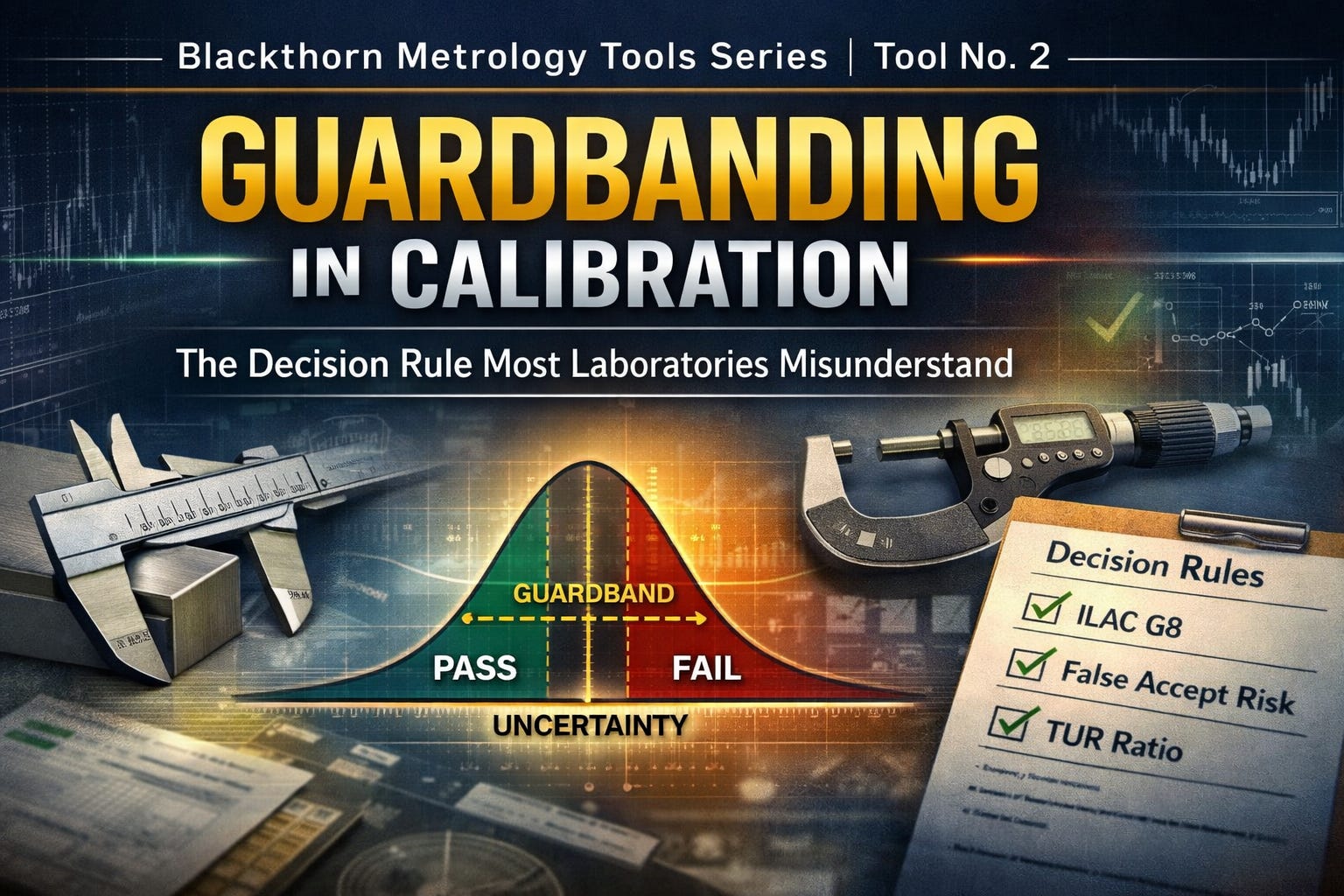
Guardbanding in Calibration: The Decision Rule Most Laboratories Misunderstand
Blackthorn Metrology Tools Series | Tool No. 2

Calibration laboratories make thousands of conformity decisions every year.
A torque wrench passes or fails.
A micrometer is in tolerance or out of tolerance.
A pressure gauge meets specification or it does not.
At first glance, these decisions appear simple. Compare the measured value to the tolerance and determine compliance.
However, modern metrology recognizes that every measurement contains uncertainty. Once measurement uncertainty is considered, the decision is no longer binary. Instead, every conformity decision carries risk.
This is where guardbanding becomes critically important.
Guardbanding is one of the most misunderstood concepts in calibration laboratories, yet it sits at the center of modern conformity assessment and ISO/IEC 17025 decision rules.
In this article we will explore:
• What guardbanding is
• Why it exists
• Where it appears in calibration laboratory operations
• How guardbands are calculated
• How laboratories should implement guardbands under ISO/IEC 17025
Subscribers will also receive the Blackthorn Guardband Calculator, designed specifically for calibration laboratories.
Introducing the Blackthorn Metrology Tools Series
Metrology is both a science and a craft.
Most calibration laboratories rely on spreadsheets, statistical tools, and measurement models to make technical decisions every day. Unfortunately, many of these tools are created informally, passed from technician to technician, and rarely validated.
Over time this creates risk.
• undocumented formulas
• broken uncertainty models
• hidden spreadsheet errors
• audit vulnerability
To address this problem, I am launching the Blackthorn Metrology Tools Series.
This series introduces practical analytical tools used in calibration laboratories and provides professionally structured calculators that laboratories can use immediately.
Each article in the series will include:
• a technical explanation of a core metrology concept
• practical implementation guidance
• ISO/IEC 17025 relevance
• a downloadable Blackthorn tool for subscribers
The first tool in the series explored En numbers used in proficiency testing.
Today we move to a topic that affects nearly every calibration certificate issued by a laboratory.
Guardbanding.
What Is Guardbanding?
Guardbanding is the practice of adjusting acceptance limits to control the risk of incorrect conformity decisions.
In other words, guardbanding accounts for measurement uncertainty when determining whether a device meets specification.
Without guardbands, laboratories compare the measured value directly to the specification limits.
Example:
Tolerance:
±1.00 °C
Measured value:
0.98 °C
Without considering uncertainty, the device would be reported as Pass.
However, if the measurement uncertainty is:
±0.25 °C
The true value could be:
0.73 °C to 1.23 °C
Now the measurement result overlaps the tolerance limit.
This creates decision risk.
Guardbanding reduces this risk by tightening the acceptance limits.
Why Guardbanding Exists
Guardbanding exists because measurements are not exact.
Every measurement includes contributions from:
• reference standard uncertainty
• repeatability
• resolution
• environmental effects
• operator influence
• instrument stability
These contributors combine to produce measurement uncertainty, typically expressed as expanded uncertainty with a coverage factor of k = 2.
If uncertainty is ignored during conformity decisions, laboratories risk making incorrect statements of compliance.
Two types of risk exist.
False Accept
An out-of-tolerance device is incorrectly accepted.
This risk is often called consumer risk because it affects the customer using the instrument.
False Reject
A conforming device is incorrectly rejected.
This is often called producer risk because it affects the calibration laboratory.
Guardbanding helps control these risks.
Guardbanding and ISO/IEC 17025
ISO/IEC 17025:2017 addresses decision rules in Clause 7.8.6.1.
When a laboratory reports a statement of conformity, the laboratory must clearly document:
• the decision rule applied
• how measurement uncertainty was considered
The standard does not mandate a specific guardband method, but laboratories must ensure that their decision rule is defined, documented, and communicated to the customer.
Many laboratories implement decision rules based on guidance from:
• ILAC G8 Guidelines on Decision Rules
• ISO 14253-1 for dimensional metrology
• internal laboratory risk policies
Guardbanding is often the mechanism used to implement these decision rules.
A Simple Guardband Example
Suppose a digital caliper has a tolerance of:
±0.001 in
The calibration laboratory reports an expanded uncertainty of:
0.0003 in
A simple guardband approach subtracts the uncertainty from the tolerance.
Acceptance limit becomes:
0.001 − 0.0003 = 0.0007 in
The laboratory now reports Pass only if the measured error falls within:
±0.0007 in
This ensures that the expanded uncertainty does not cross the specification limit.
This approach is commonly known as simple guardbanding.
More advanced guardband methods consider probability and statistical risk.
Guardbanding and Test Uncertainty Ratio (TUR)
Historically, many laboratories relied on the 4:1 Test Uncertainty Ratio rule.
If the laboratory uncertainty was four times better than the tolerance, the instrument could be evaluated directly against the specification.
However, modern measurement science recognizes that TUR alone does not control decision risk.
Guardbanding provides a more rigorous method for controlling conformity decisions when TUR is small.
In fact, many modern calibration programs combine:
• measurement uncertainty
• guardbanding
• probability of false accept analysis
How Laboratories Should Implement Guardbanding
A robust guardband policy typically includes:
Documented Decision Rules
Defined in the quality manual or calibration procedures.
Consistent Calculation Method
The guardband must be calculated consistently across calibrations.
Customer Communication
The decision rule must be communicated when statements of conformity are provided.
Software or Spreadsheet Control
Guardband calculations should be performed using validated tools.
This last point is critical.
Many laboratories attempt to perform guardband calculations manually or through poorly structured spreadsheets. This creates unnecessary risk.
The Blackthorn Guardband Calculator
To support calibration laboratories, subscribers can download the Blackthorn Guardband Calculator.
The tool includes:
• specification limits input
• expanded measurement uncertainty input
• automatic guardband calculation
• adjusted acceptance limits
• pass/fail decision output
The workbook also includes:
• built-in formula transparency
• validation record tab
• Blackthorn documentation structure
• ISO/IEC 17025 defensibility
This tool is designed specifically for calibration laboratories implementing decision rules and guardbanding policies.
Final Thoughts
Guardbanding may appear to be a minor technical detail, but it sits at the heart of modern conformity assessment.
Every calibration laboratory must confront the reality that measurements contain uncertainty. Guardbanding provides a structured way to manage the risk associated with that uncertainty.
When implemented correctly, guardbanding strengthens the credibility of calibration results, improves risk control, and aligns laboratory practice with international metrology guidance.
In the next article in the Blackthorn Metrology Tools Series, we will examine another concept that calibration laboratories frequently misunderstand:
Test Uncertainty Ratio.
Excellent breakdown for the masses!!